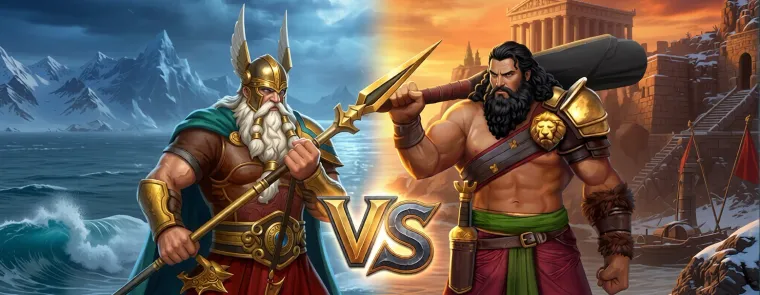
Hercules or Heimdall
2026-09-22
The question every player asks sooner or later, and the answer turns on something that is not in either captain’s card.
Why these two
New players ask it and so do players who are not new at all: which captain is the best in the game against epic monsters.
Against an epic, the stat that decides the fight is your army’s strength. Health buys you nothing there, because everything you send dies either way. Read the captain list with that in mind and two names come back: Hercules and Heimdall.
What each one gives
Hercules adds 2 % army strength against epic monsters, per level. Heimdall adds 1.5 % army strength per level, in every fight there is — epics, players, citadels, all of it.
That would settle it if levels were all a captain had: Hercules for epics, Heimdall for everywhere else. They are not. The star bonus is the other half of a captain, and it is where the comparison stops being simple.
The stars are the whole argument
Heimdall’s star ladder is flat. Every star past the first is another 110 %, all the way to 660 % at seven. Beowulf and Skadi climb the same way.
Hercules’ does not climb, it accelerates: 30, 90, 180, 300, 510, 860. Through the middle he is far behind, and then the last two stars run away with it.
So which captain is ahead depends on both numbers at once, and at every star count there is a level where they cross.
What the chart says
Set each captain to whatever stars you want to compare — they need not be the same — and it marks the level at which one overtakes the other. Two readings matter more than the rest, and both take a seven-star Heimdall as the benchmark, because that is the one a player can reach by playing.
- A five-star Hercules never catches him. 300 % against 660 % is a gap the level bonus would close at level 720, and the game stops at 600.
- Six stars is where it turns, and only from level 300 up. Below that, the seven-star Heimdall is still ahead even in the fight Hercules was built for.
What the stars cost
This is the part that decides it, and it is not on either card.
Heimdall’s fragments come out of the Seasonal Kingdom and out of Season’s Legacy, the event that follows it.
Hercules’ come from the Triumphal Challenge sales, bought with real money. The pack itself is 50 fragments for $100, but it does not appear until you have bought the two before it, at $50 and $100 — those are the ones carrying mercenaries, gold and resources. So the first 50 fragments cost $250. The 300-fragment pack later in the month is gated the same way, and brings that month to $1,400 for 350 fragments. Prices move by country.
Five stars is 850 fragments all in: 50 to hire him, then 80, 120, 200 and 400. Seven is 3,250. There is a ceiling of 350 fragments a month, so neither can be done in one go.
- Two months at the full $1,400 buys 700 fragments. Three more at $250 each add the last 150: five stars for $3,550, across five months.
- A third full month instead gets there sooner. $4,200 in three months lands at 1,050 fragments — five stars and 200 to spare.
Heimdall is not free either
Unlocking him means getting into a Seasonal Kingdom, which wants guardsmen at level 5 and comes round twice a year. Taking him to a high star count means playing that season seriously for its whole run, and probably spending something along the way.
It is a real cost. It is not the same order of cost.
Where Hercules does win
You can have him almost from the start, without waiting six months for the next Seasonal Kingdom. That is worth something to an account that wants to grow now.
And against an epic, one star of Hercules beats anything else you can get outside a Seasonal Kingdom. Next to Cleopatra it is not close.
So which
Like anything that comes down to money, it depends on what you are willing to spend. For some players the price of a good Hercules is not a problem. For a great many more, $250 is already past what they want to put into one captain.
If you want to grow fast from the start and will not wait for the next Seasonal Kingdom, a one-star Hercules is the best captain available to you by a wide margin.
For almost everyone else, it is Heimdall.